First: emit electrons in a vacuum chamber and confine them, as
far as possilbe, in an electric field (although they will escape
sidewards). Try to see the trayectories of the electrons.
Second: confine the electrons in an electric and in a magnetic
field.
Third: introduce deuterium ions in the vacuum chamber and
investigate if they are atracted by the confined electrons cloud in
the centre of the vacuum chamber, and if they, maybe, fuse with each
other...
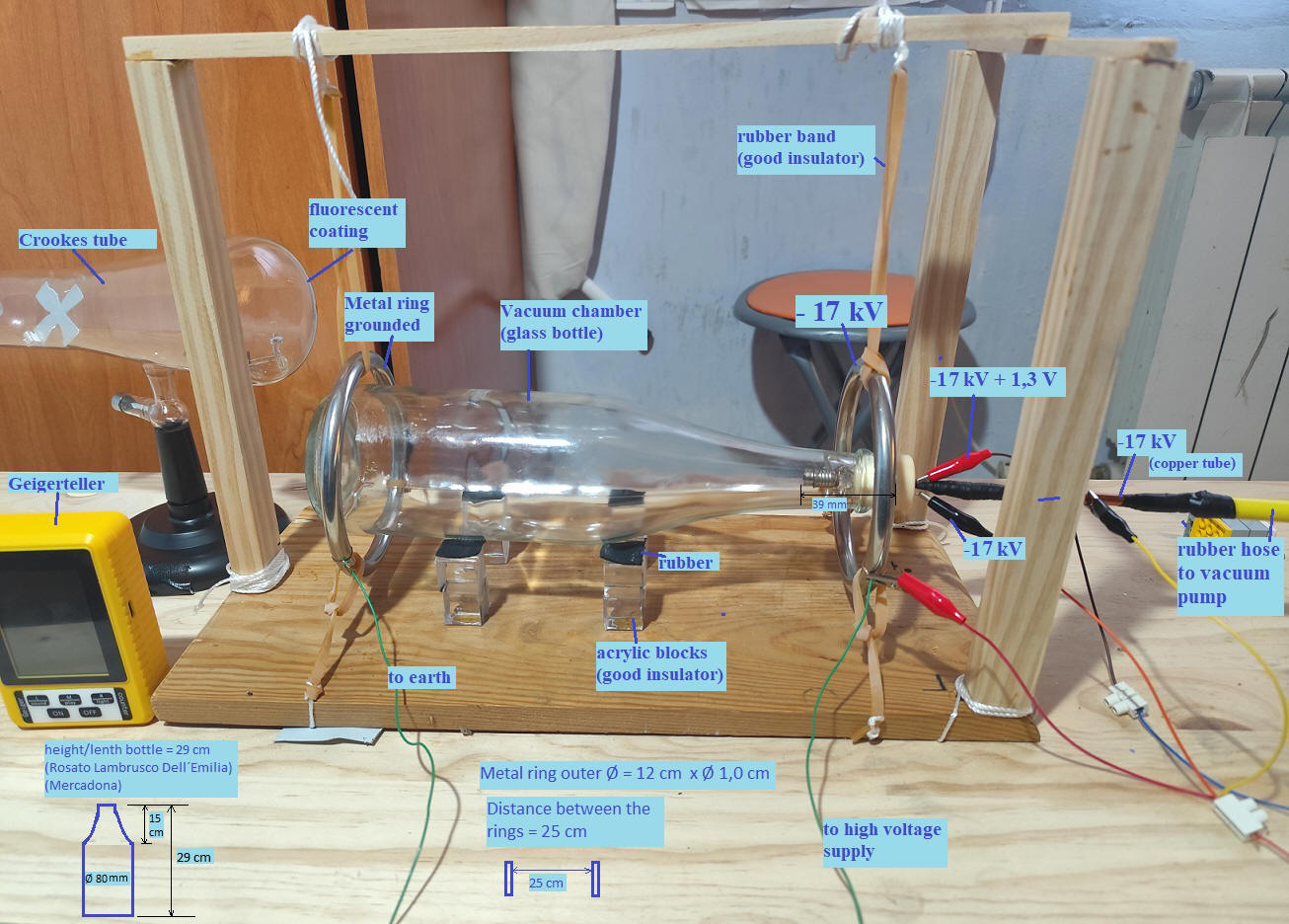
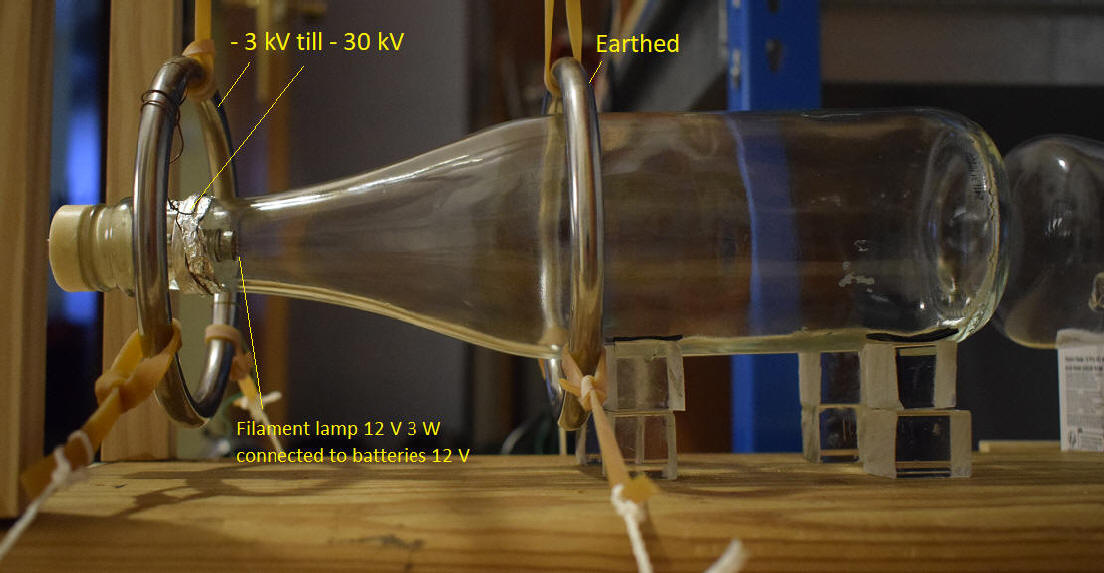
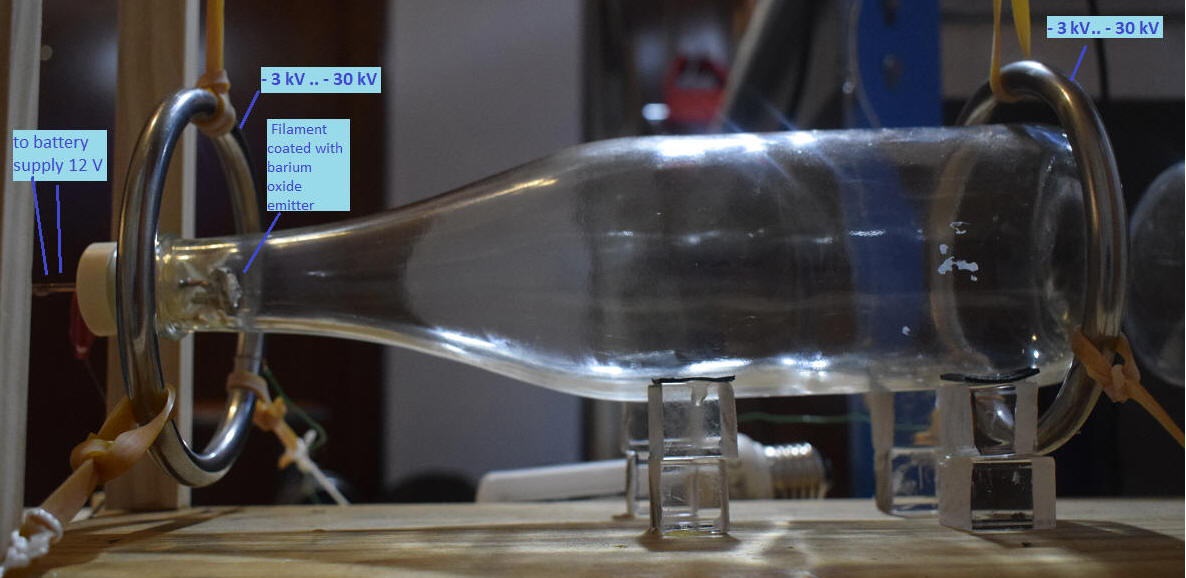
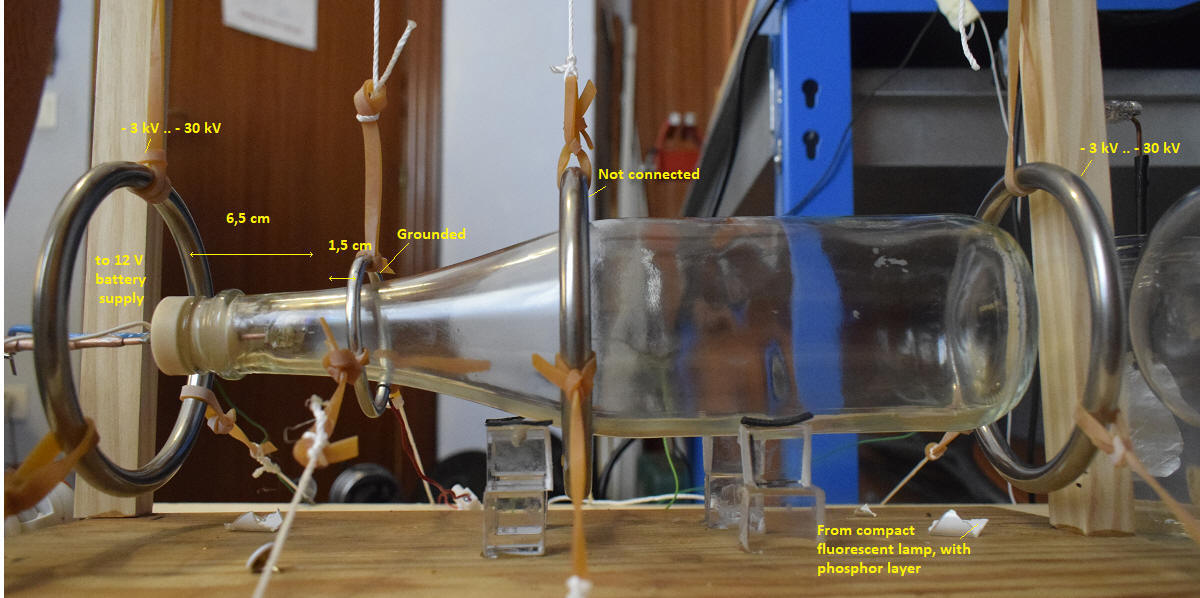
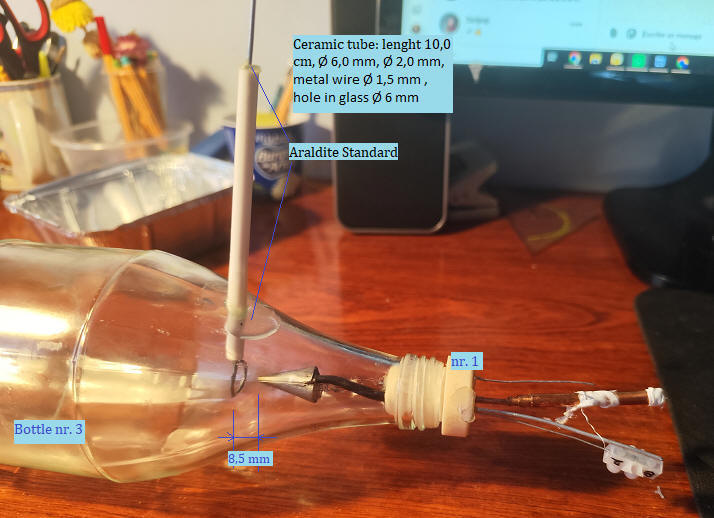
As vacuum chamber I will use, for the moment, a glass bottle.
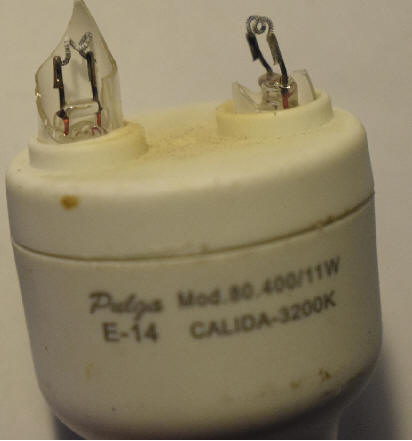
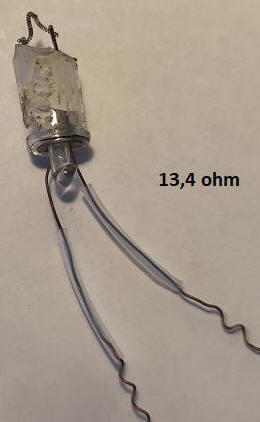
As electron emitter I will use, first, a filament of a small
incandescent lamp and later, a filamente of a compact fluorescent
lamp
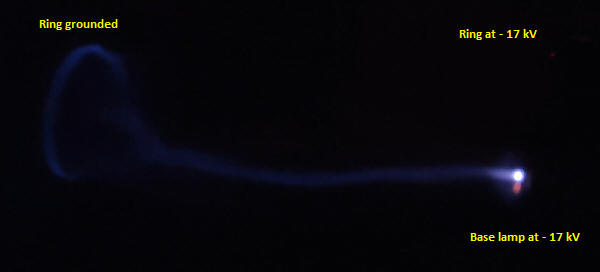
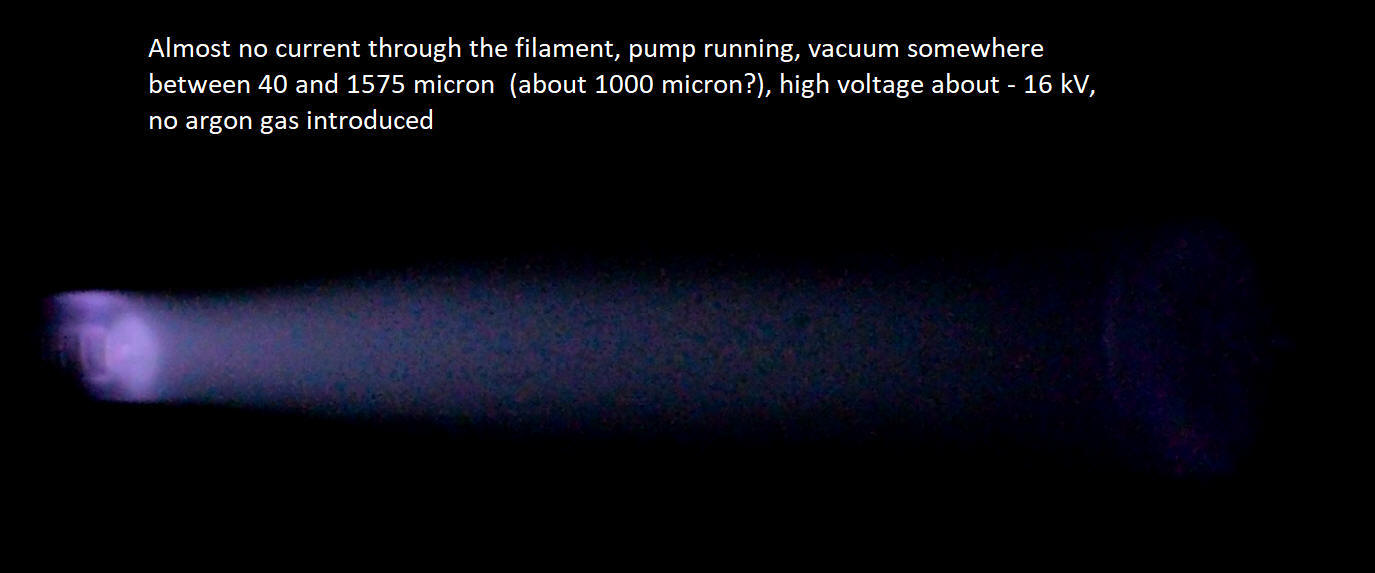
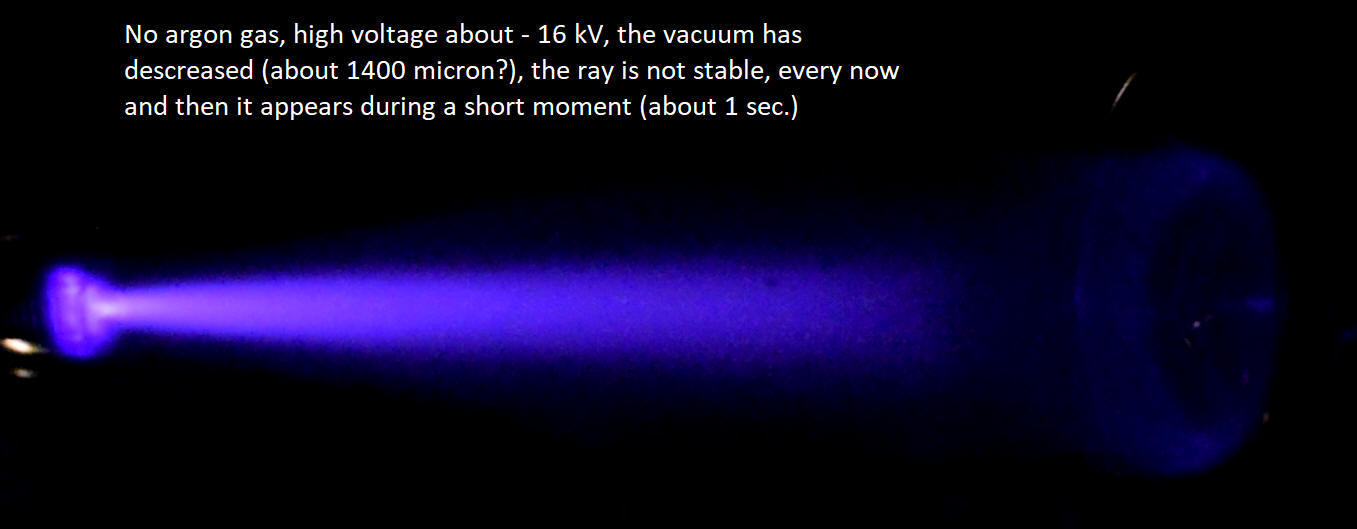
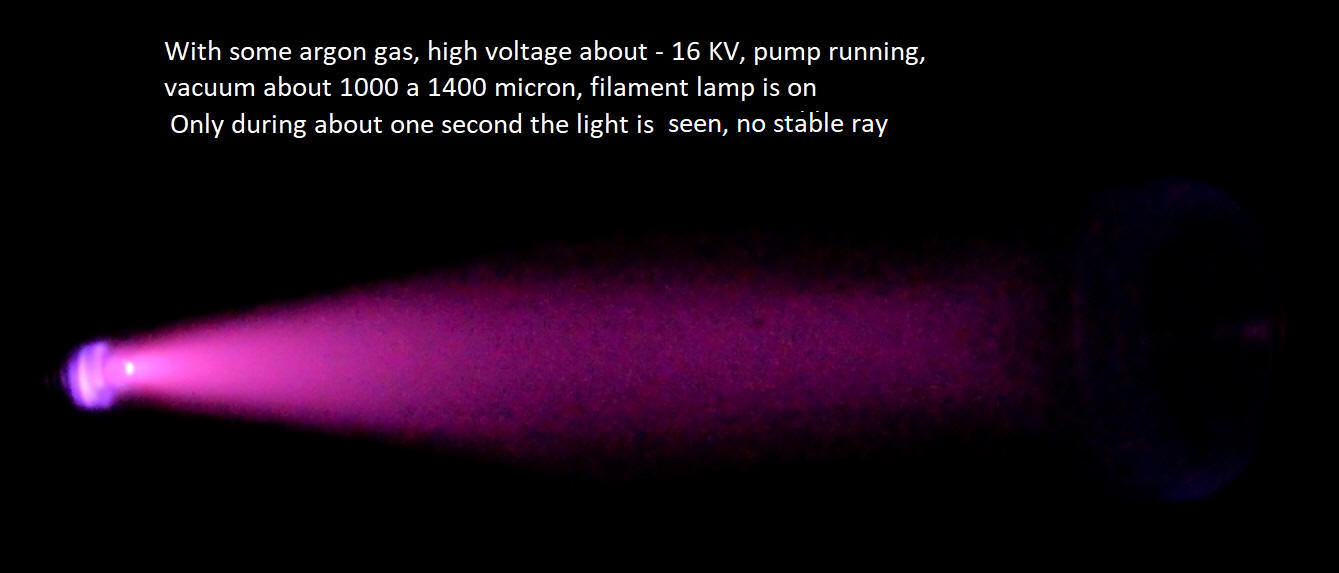
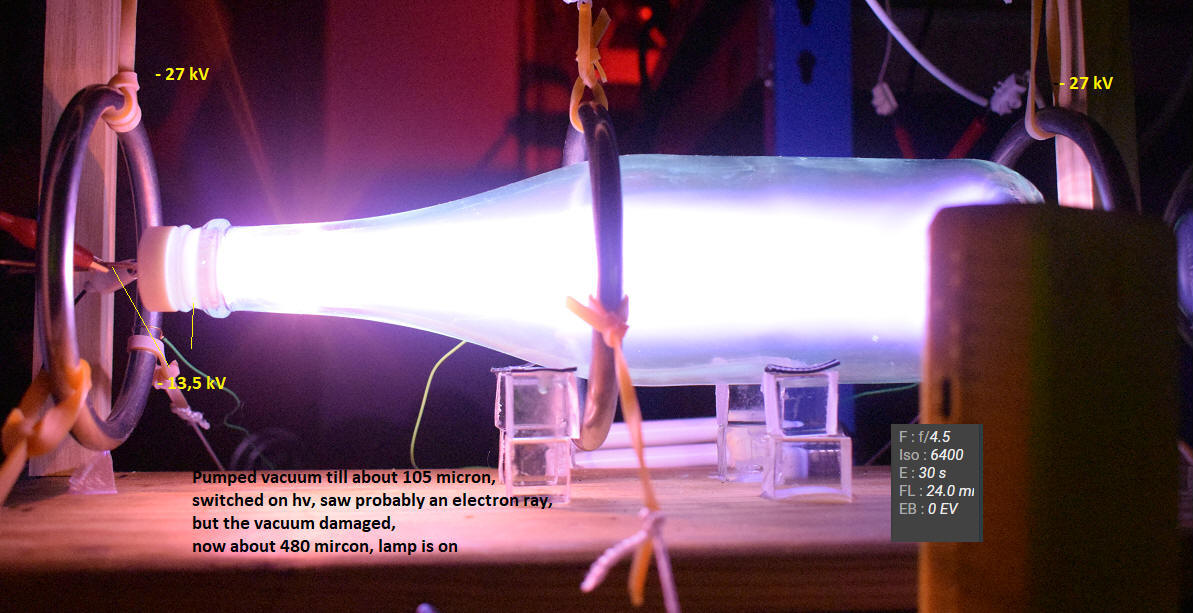
This ray/glow was seen during about 3 seconds, with the high
voltage output at - 17 kV
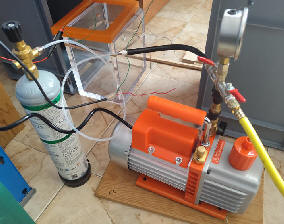
I still not had a digital vacuum meter. The glycerine vacuum meter
was not so accurate, vacuum was about - 29,2 InHg, but the
vacuum was not good.
Experimental setup same as in the first experiment. (also the
same cap and hose)
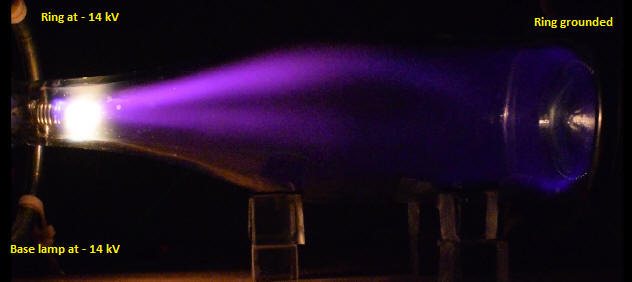
The first ring and the base of the lamp/filament are now charged
with about - 14 kV
The second ring is grounded.
I received the new digital vacuum meter, and can now measure more
accurately the pressure.
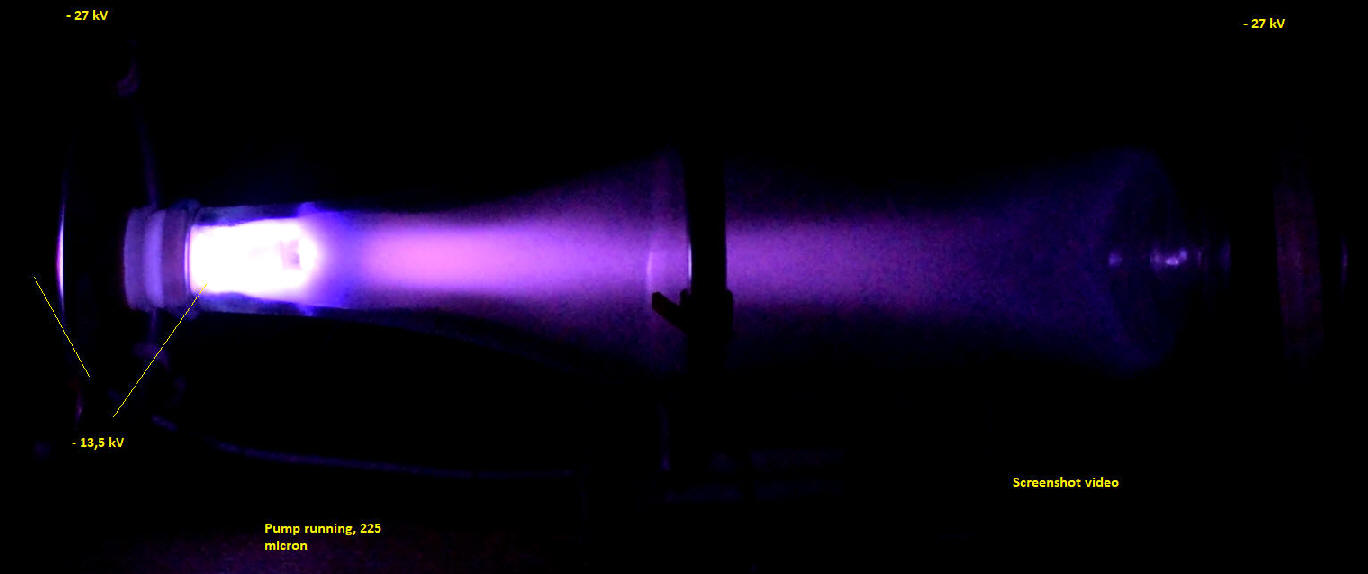
Vacuum > 225 micron, leaking
The ray/glow was seen durng about 10 seconds. The filament burned.
Experimental setup same as in the first experiment. (also the
same cap and hose)
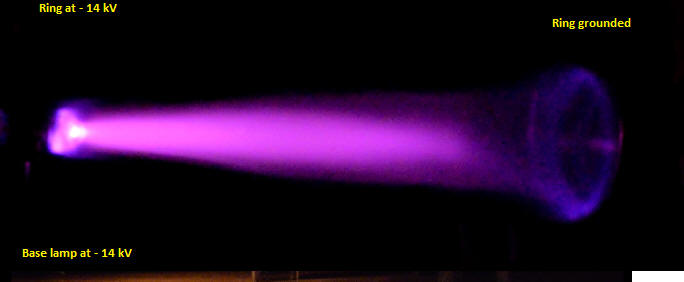
The base and the first ring connected to the high voltage, the
second ring grounded.
With the pump on and pumping, vacuum = 260 micron (- 29,911 Inhg), hv
= about -14 kV / position 4, with this high voltage the bigest
effect (ray/glow) is seen
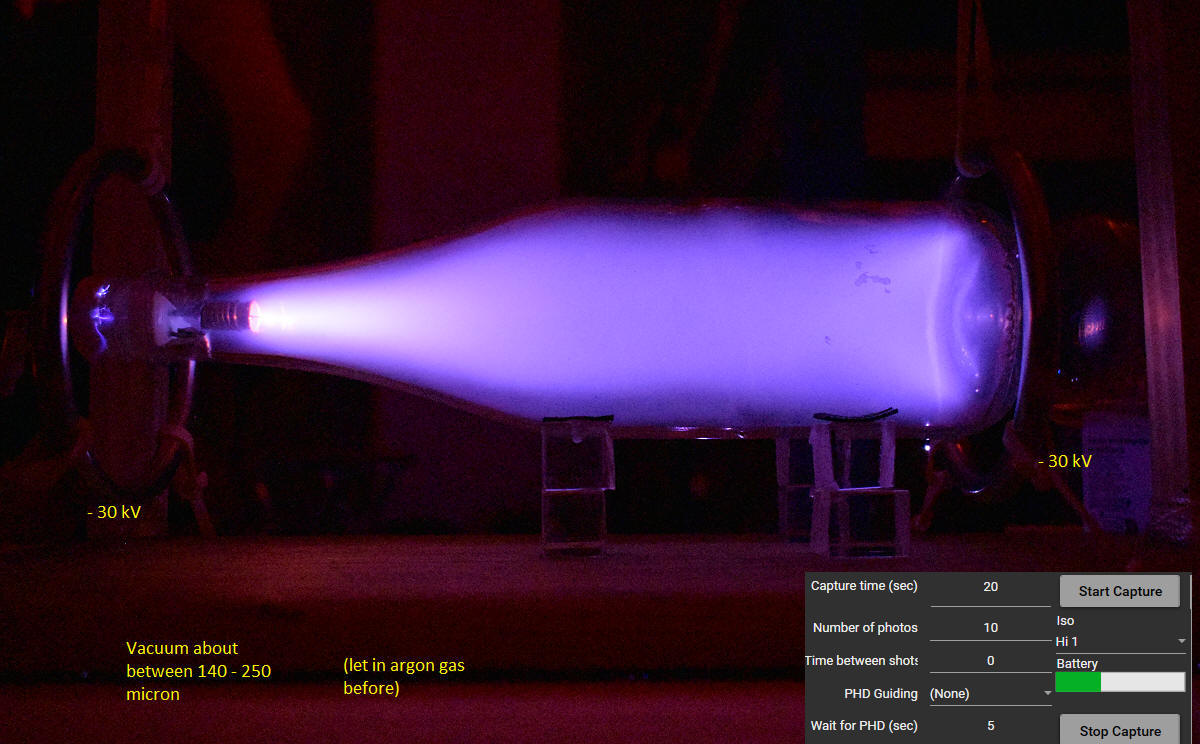
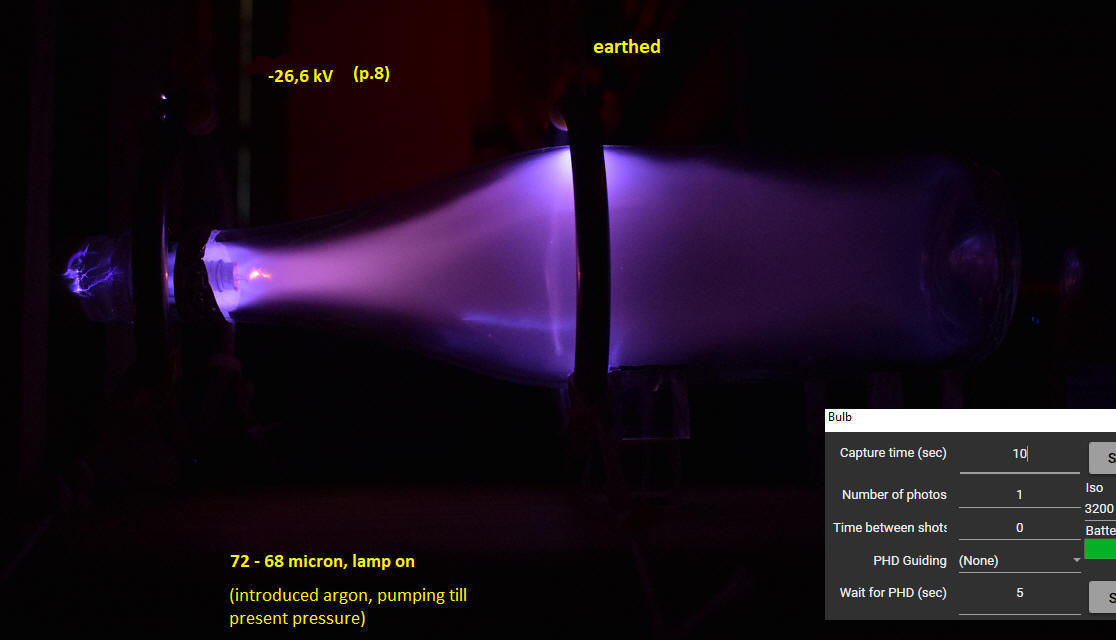
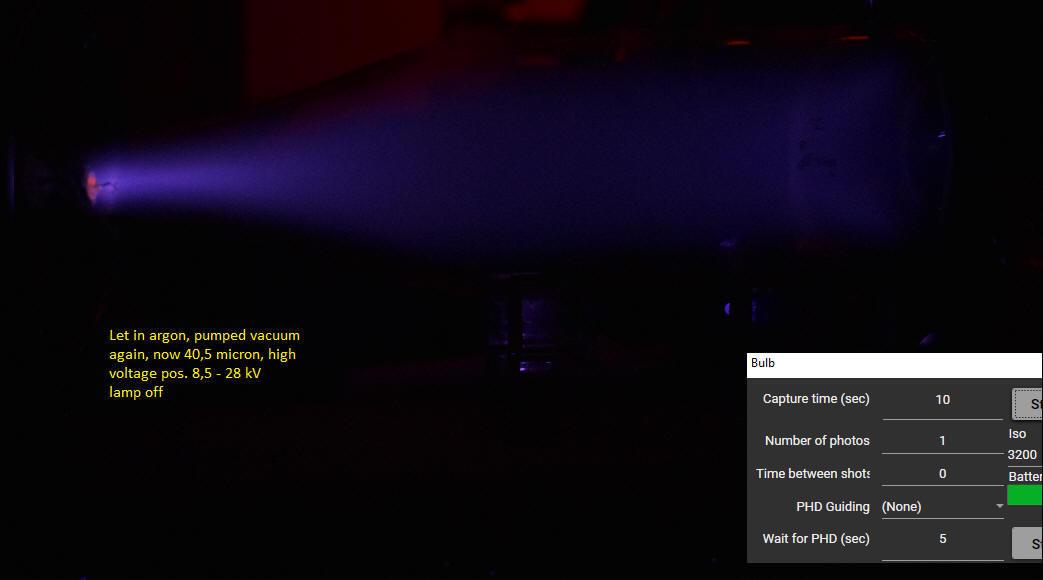
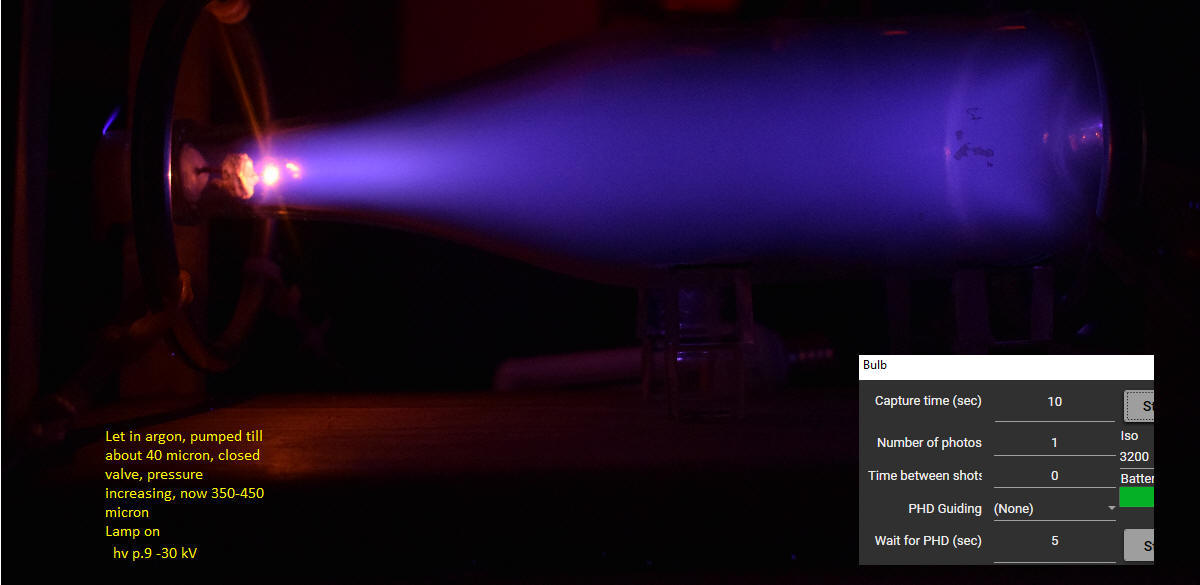
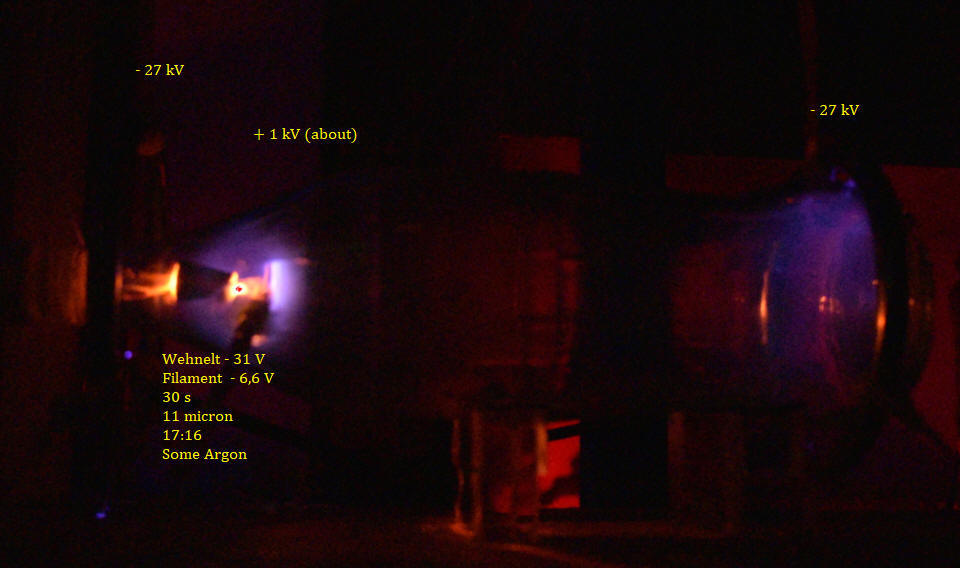
Electron Beam in Argon Glow
– Experimental Observation
In this
experiment, a narrow beam of electrons was produced inside a small
glass vacuum chamber filled with low-pressure argon gas (about 260
microns). The cathode consists of a heated filament connected to −14
kV and a ,metal ring just behind the filament located outside the
vacuum chamber, while the anode is a grounded metal ring placed 25
centimeters away and also located outside the vacuum chamber.
The violet
glow seen in the photo corresponds to argon emission lines excited
by electron impact. Near the filament, electrons are emitted and
accelerated forward, forming a well-defined glowing column. The
bright spot on the opposite side marks where the electrons strike
the glass wall, producing characteristic argon fluorescence.
The
discharge is stable and quiet, indicating a balance between electron
energy and gas density. At higher voltages, the glow tends to
collapse, likely due to local space-charge effects that screen the
accelerating field.
This
setup demonstrates how a focused electron beam can be formed and
visualized in a simple static configuration — a first step toward
understanding charged particle confinement in the
Static Electromagnetic
Fusor (Sem Fusor) concept.
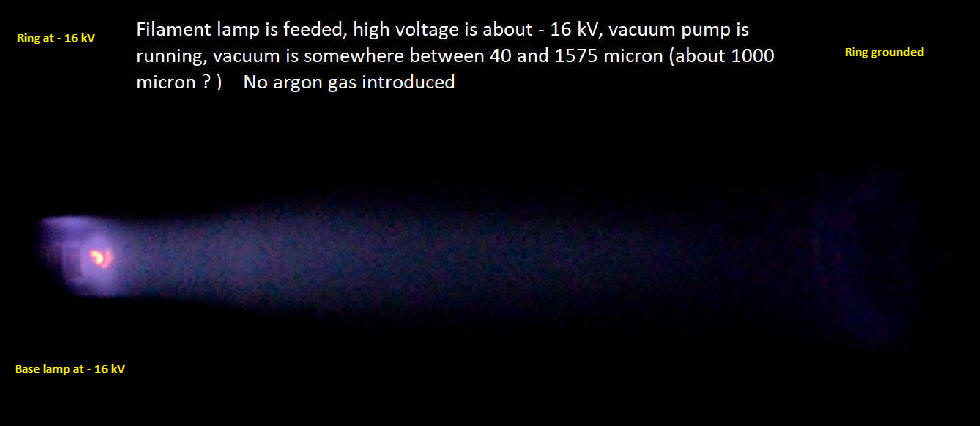
Experimental setup same as in the first experiment. (changed cap
and hose, made new ones)
The base and the first ring connected to the high voltage, the
second ring grounded.
After about 16 minutes the vacuum reached 37,6 micron.
After starting the experiment the vacuum started leaking.
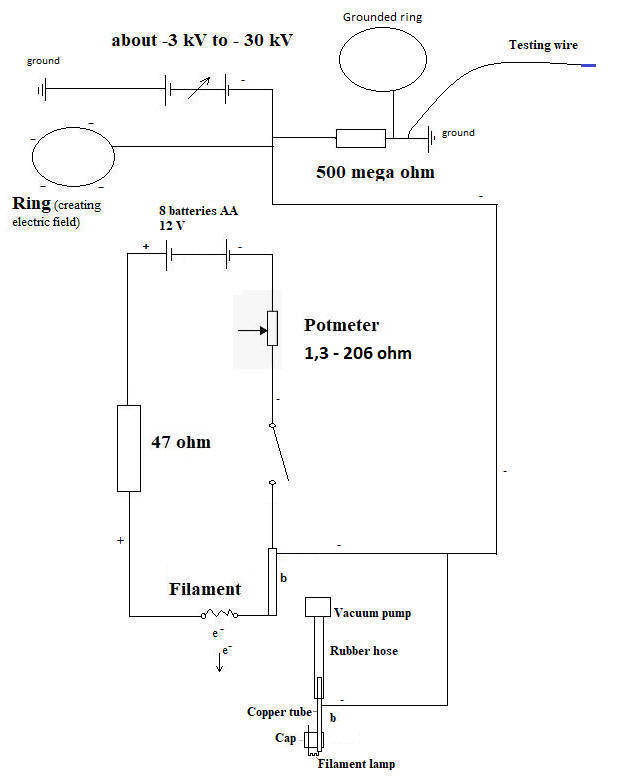
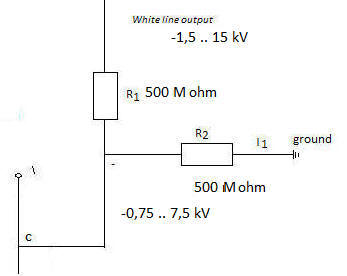
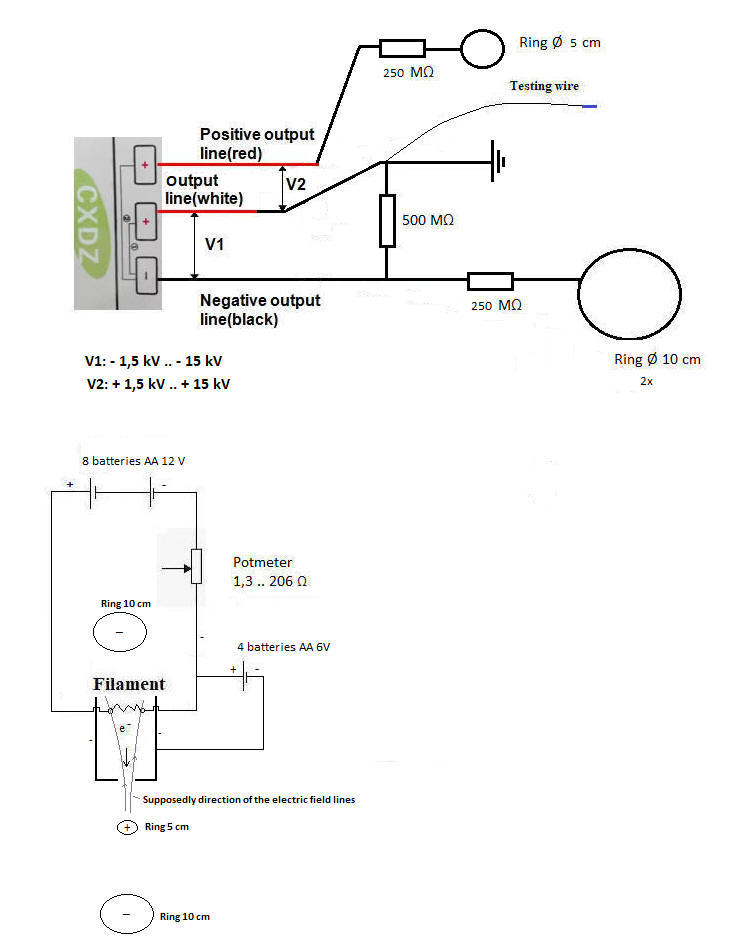
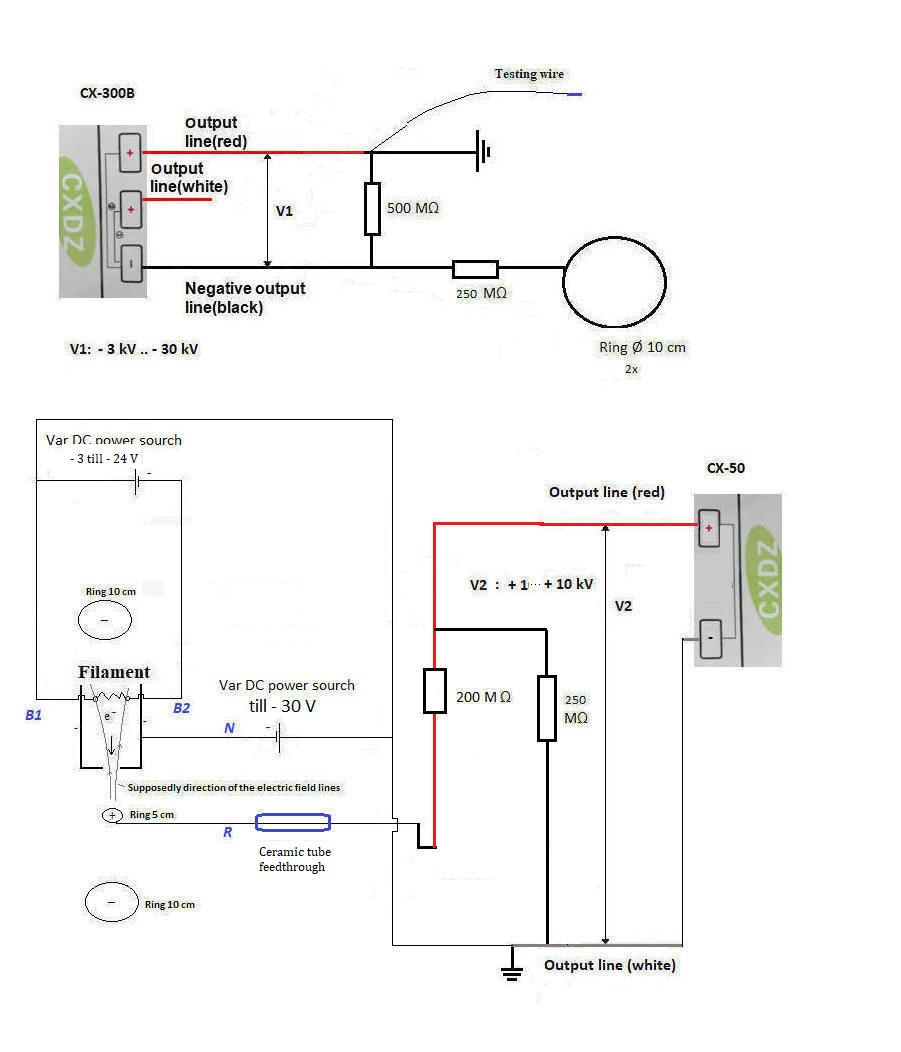
The electrical scheme.
24-2-2026 Measure current between - hv black outlet - multimeter
- 500 M ohm - earth : position 1 = 2,3
μ A , position 2 = 4,8 μ A -> there is a small
leak current, necessary for the hv supply (without leak current
it can damage) pos.1 -> 1,5 kV I = 1,5 E3 / 500E6 =
3E-6 A = 3 μ
A, so more or less the same as measured.
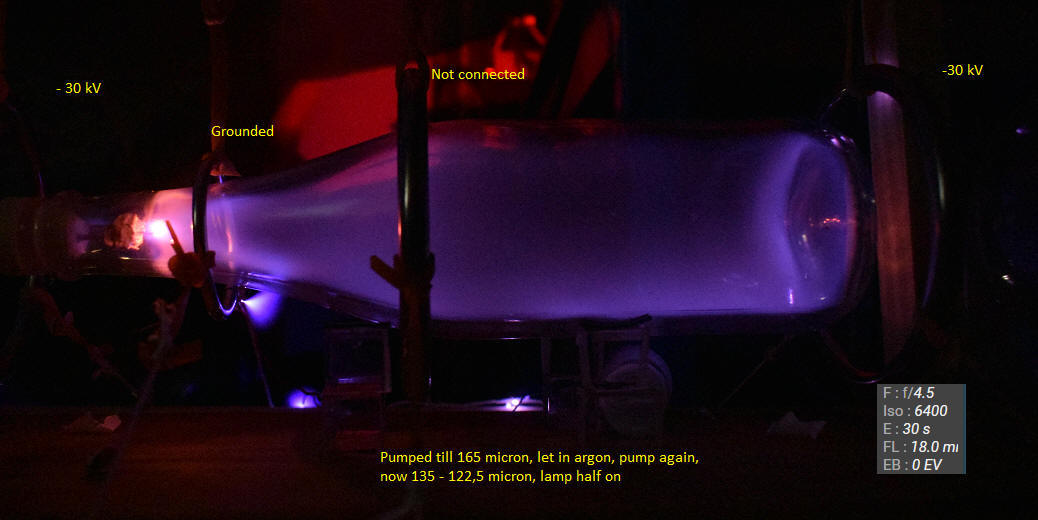
Both rings at - 30 kV (base lamp not connected to
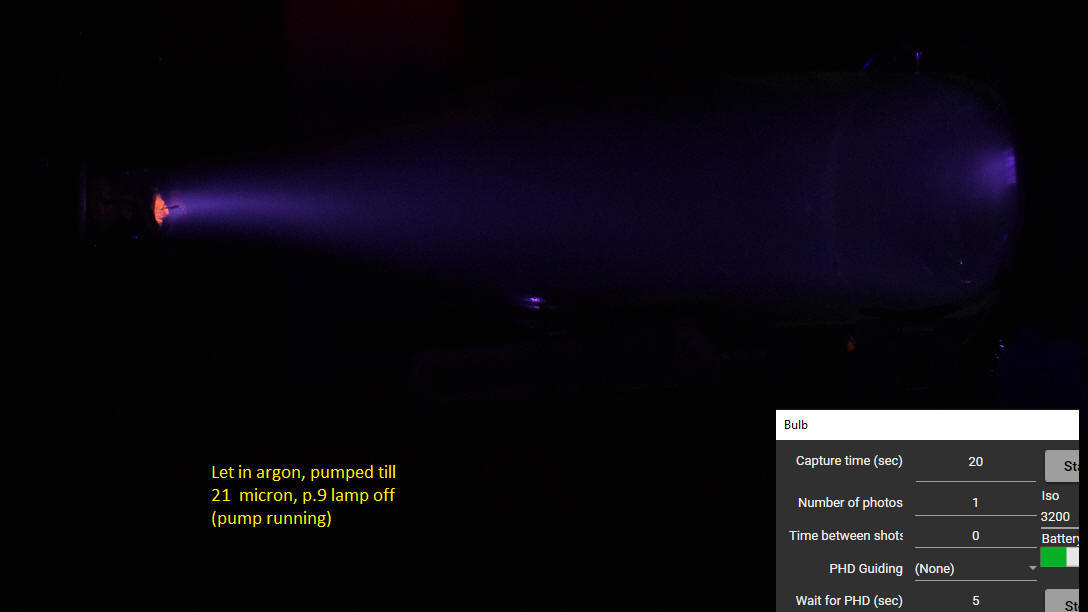
high voltage) I made some more photos with different pressures. Between
41 and 950 micron a bluish glow was seen (but not exluding other
pressures).
The small lamp switched on or off made , as far as I could see, no
difference.
Deepest vacuum was 33,7 microns. Below 75 microns the bluish glow
got dimmer.
AI: Gas emits light in a strong electric field, a
process known as electric discharge or gas discharge. The
field accelerates free electrons, which collide with gas
atoms/molecules, exciting them to higher energy levels. As
these excited atoms return to lower energy states, they emit
light.
Key Aspects of Gas Emission in Electric Fields:
Mechanism: The strong electric field accelerates free
electrons. These high-energy electrons collide with gas
molecules, transferring energy and creating excited
(high-energy) states.
Emission: Excited molecules return to a lower energy state
(ground state) by releasing the excess energy as light,
often in the visible spectrum.
Color Specificity: The color of the light depends on the
gas's atomic structure (e.g., neon glows red-orange, argon
glows purple-blue).
Examples: This principle is used in neon signs, plasma
tubes, and fluorescent lamps.
Conditions: A strong field is needed to ionize the gas,
often at low pressure, which allows the electrons to gain
enough speed before colliding with another atom.
This phenomenon is essentially the creation of a plasma,
where the gas becomes ionized and conductive, releasing
energy in the process
In discharge lamps there is an anode and a cathode. Here there
are neither an anode nor a cathode, only two charged rings outside
the vacuum bottle. (?)
I think that (perhaps) the base of the lamp connected to the vacuum hose
works as an anode and a tiny amount of electrons travels from the
charged rings to the glass.
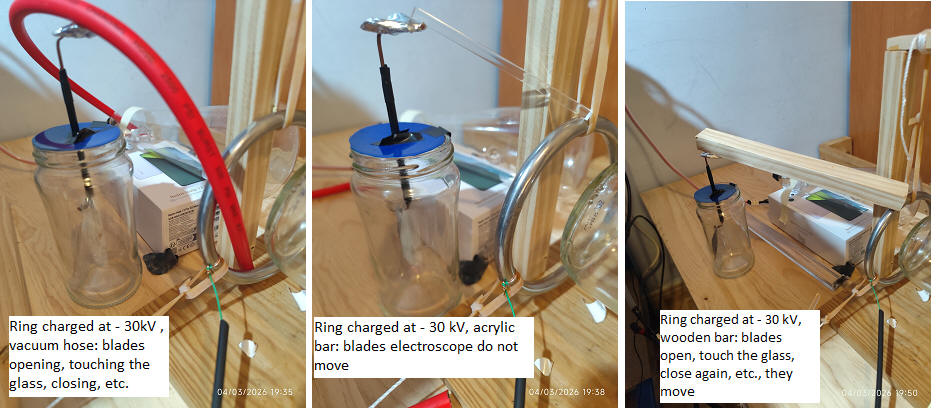
I tested before also acrylic and wood with an electroscope. See
Youtube: experiments with electroscope
Now I tested a vacuum hose.
Result: the vacuum hose conducts a little electricity if high
voltage is applied (the electroscope blades get charged, move, touch
the glass, discharge and close, get charged again..).
--------------------------
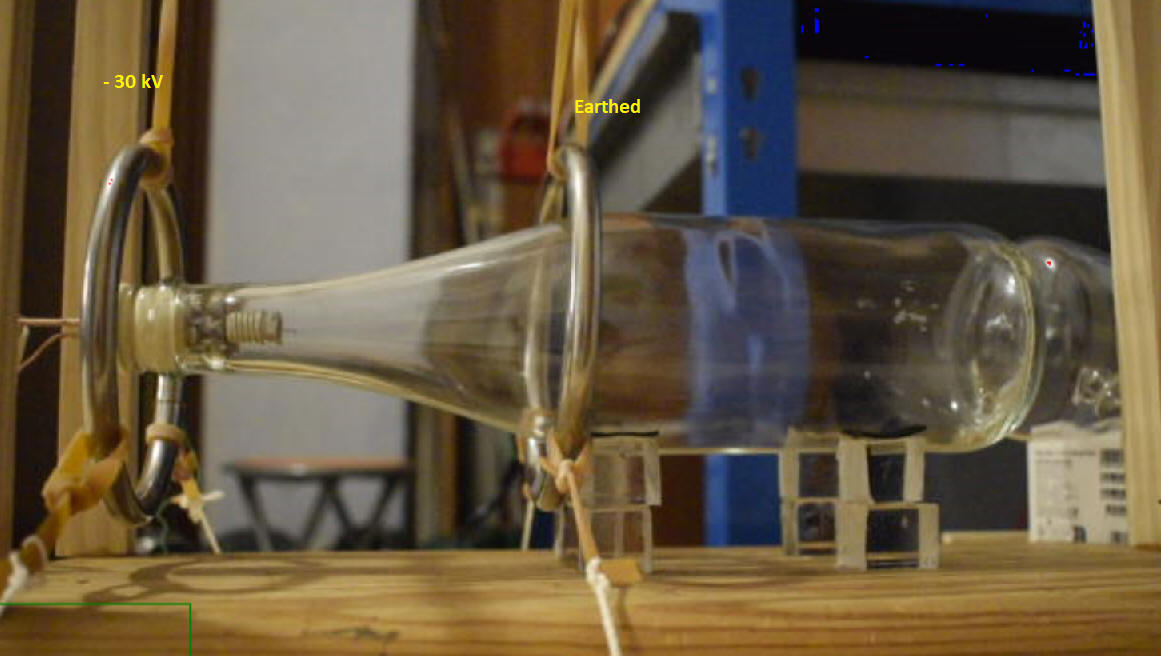
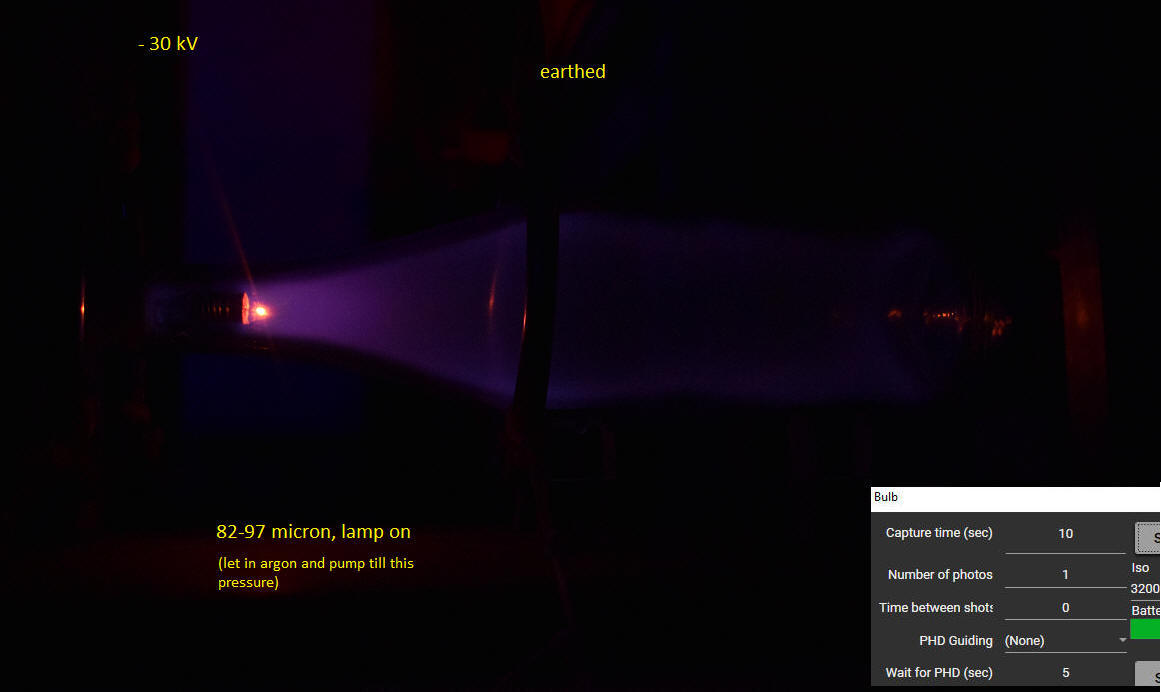
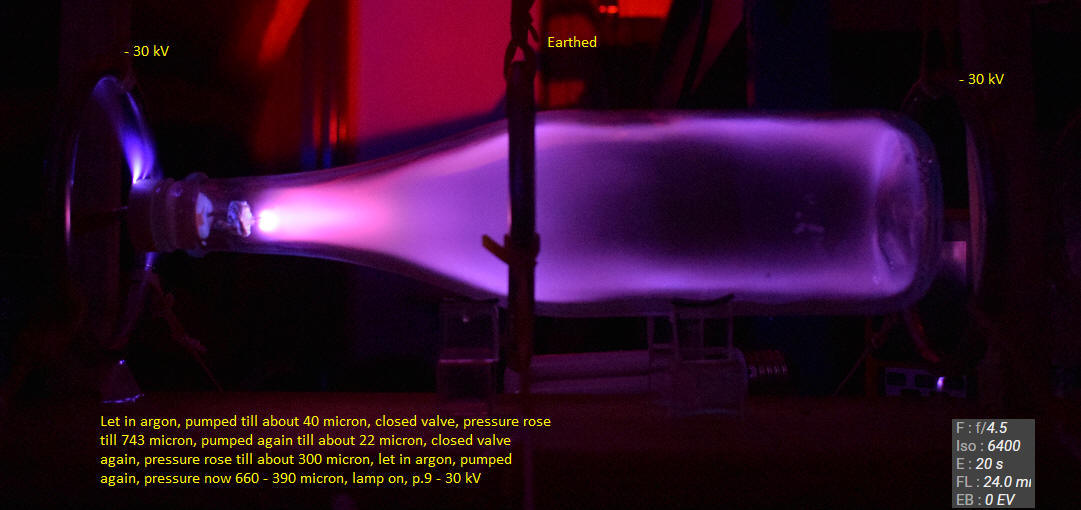
Now the first ring is charged at - 30 kV and the other ring is
earthed a placed in the centre of the vacuum bottle.
The lamp on or off made, apparently, now difference. A bluish glow
was seen, with pressures between 68 and 562 microns (not exluding
higher pressures).
With 50 microns almost no glow was seen. (note:
the capture time was now 10 s, before 20 s)
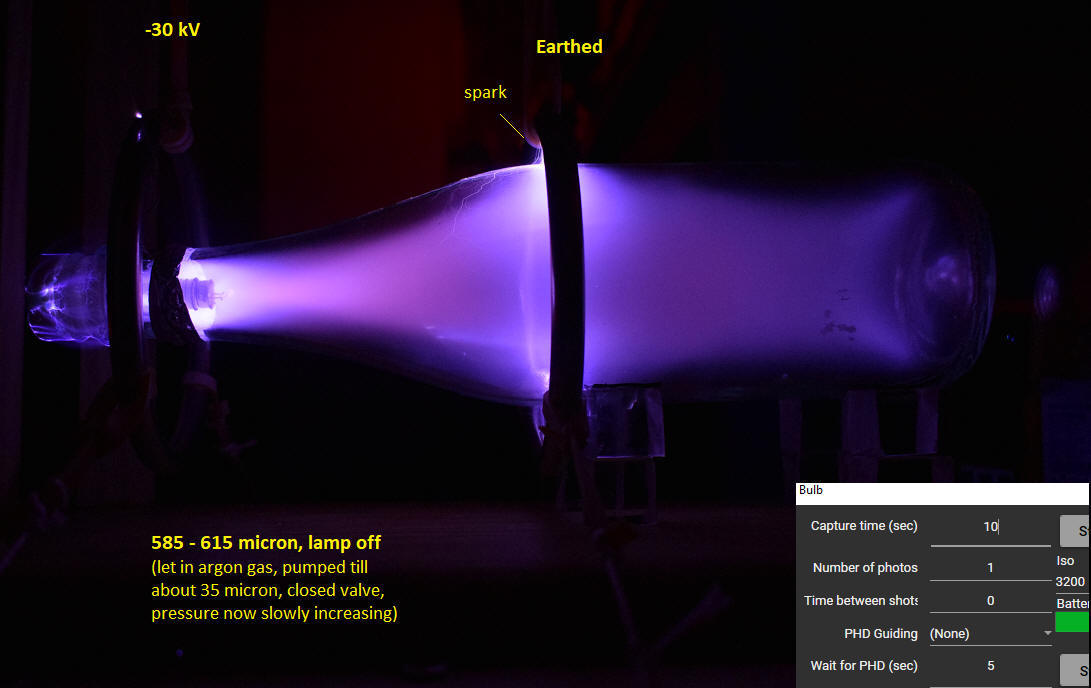
Wrapped some aluminum foil around the neck of the bottle and
connected this to the first ring, just trying out..
Lamp on or off made apparently now difference. Pressure between
58 and 637 microns. A bluish glow was seen, brighter than before,
probaby because now more energy (more electrons) is coming in
the vacuum bottle, because the negatively charged aluminum foil
makes now direct contact with the glass bottle.
With - 30 kV (the first ring and the aluminum foil), a more or less
constant spark was formed between the glass bottle and the earthed
ring. The glow was also brighter.
-----------------------------------
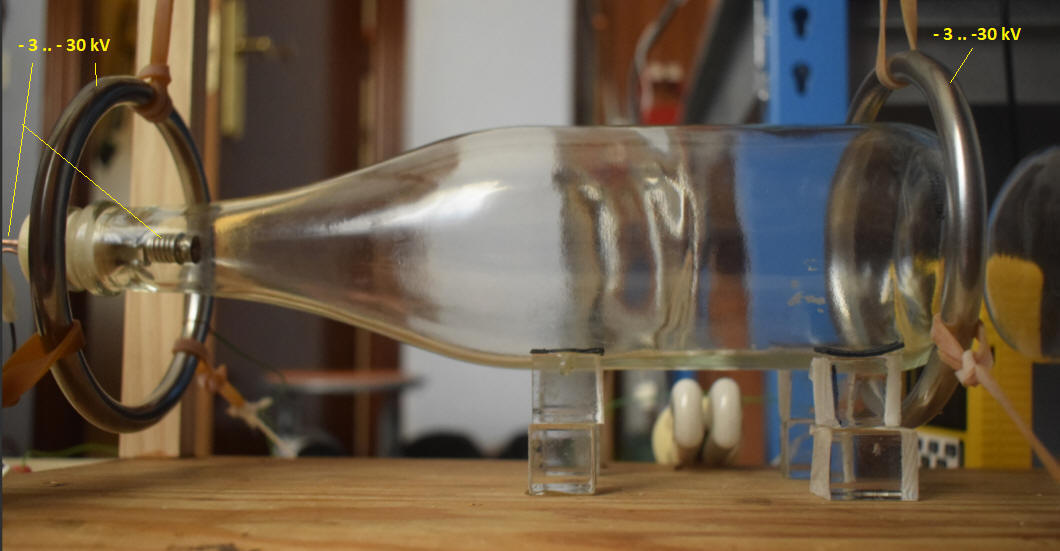
Now the first and second ring and the base of the lamp are connected
to the high voltage.
More or less with this high voltage and this pressure there was
more or less a constant bluish glow.
The glow was a lot brighter than before (when only the rings
charged). My explanation: via the
base of the lamp a lot more electrons are pumped inside the vacuum
bottle, more energy, so more light is produced.
Unfortunately there occured suddenly a vacuum leakage, just when I
switched off the lamp. Coincidence?
I found out that the vacuum leak always occured when I connected the
base of the lamp to the high voltage.
First I thought that the leakage occured in the cap/syntetic corch.
But when I used an old vacuum hose (cutting the supposedly
deteriorated cap from it), connecting a new cap to it, it leaked...
So the leakage occured in the vacuum hose/coupling vacuum hose
(although I do not excude leaking in the cap/corch as well).
What could have happened, according my hypothesis: the base of the
lamp is connected to - 3 till - 30 kV. Electrons are expelled from
this base, the cathode, and the residual gas in the vacuum bottle is
ionized. The glass of the bottle is charged negatively? When
using a earthed ring a spark was produced between the glass bottle
and the earthed ring, see before, so effectively the glass is/can be
charged.
-----------------------------
I will now use a filament of a CFL (compact
fluorescent lamp), this filament is coated with barium oxide
emitter paste.
AI:
Filaments in Compact Fluorescent Lamps
(CFLs) are efficient electron emitters because they are
designed for thermionic
emission, utilizing a specialized coating to
release large numbers of electrons at relatively low
temperatures.
Here is why they are effective:
Barium Oxide Coating: The tungsten filaments
are coated with a mixture of alkaline earth oxides,
typically barium
oxide (BaO), which acts as a low-work-function
material. This coating requires less heat to release
electrons compared to bare metal filaments.
Thermionic Emission Mechanism: When the lamp is
turned on, the filament heats up rapidly and, due to the
coating, emits a high density of electrons into the
tube, initiating the ionization of the mercury vapor.
Coiled-Coil Structure: The filaments use a
"coiled-coil" or "triple-coiled" structure, which
increases the surface area for the emission coating,
further enhancing electron output.
Controlled Heating: The electronic ballast
provides a specific "kick-start" to heat the electrode,
enabling it to emit electrons efficiently, after which
it functions as a cathode to maintain the arc.
This process allows the CFL to create a high-density
stream of electrons that strike mercury atoms, producing
UV light, which the phosphor coating then converts into
visible light.
More experiments
Made again a new cap + vacuum hose.
The two rings connected to the high voltage.
I made several more photos, a bluish glow was seen, it did
apparently not make difference if the lamp/filamente was switched on
or off.
Now the base of the lamp is not connected to the high voltage,
the vacuum (hose, cap) has not been deteriorated.
I moved the bottle to the right. Distance between the rings is the
same, 24 cm.
The filament is now 5,8 cm right from the
centre of the first ring.
At this distance the electric field of the ring with diameter 10 cm
is more or less the stongest, according my simulation program.
I did some experiments and made some photos, the results are
simular as before, only a bluish glow was seen, independent of the
filamente being on or off.
Also I did experiments with the centre ring grounded, and
made several photos, with different pressures. The results wer
simular as before, see under.
The color here is more pink, due to the residual argon (I suppose).
Curious is this color distribution, more brighter near the wall of
the bottle. Sometimes this distribution appeared.
During the experiments, when I switched off the high voltage, the
glow disappeared. When I switched on again the high voltage, more or
less till - 30 kV, sometimes it took some time
before the glow
started. It could be that switching off and on the small lamp could
have any influence, but I am not sure.
I moved also a small magnet near the bottle. I saw some movement
of
the pink/purple colour.
----------------------
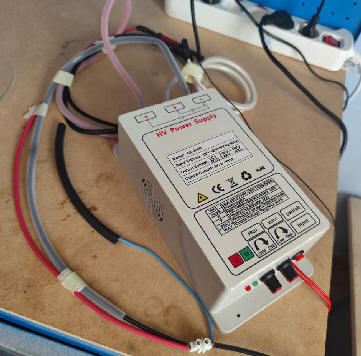
I connected the base of the lamp to the white outlet of my high
voltage supply, that gives - 1,5 kv till - 15 kV, conected this with
two restances of 250 MΩ
to earth, and took the voltage
from between these two resistances, to get - 0,75 kV till - 7,5 kV.
Results: only a bluish glow, like before when only the two rings
charged.
----------------------
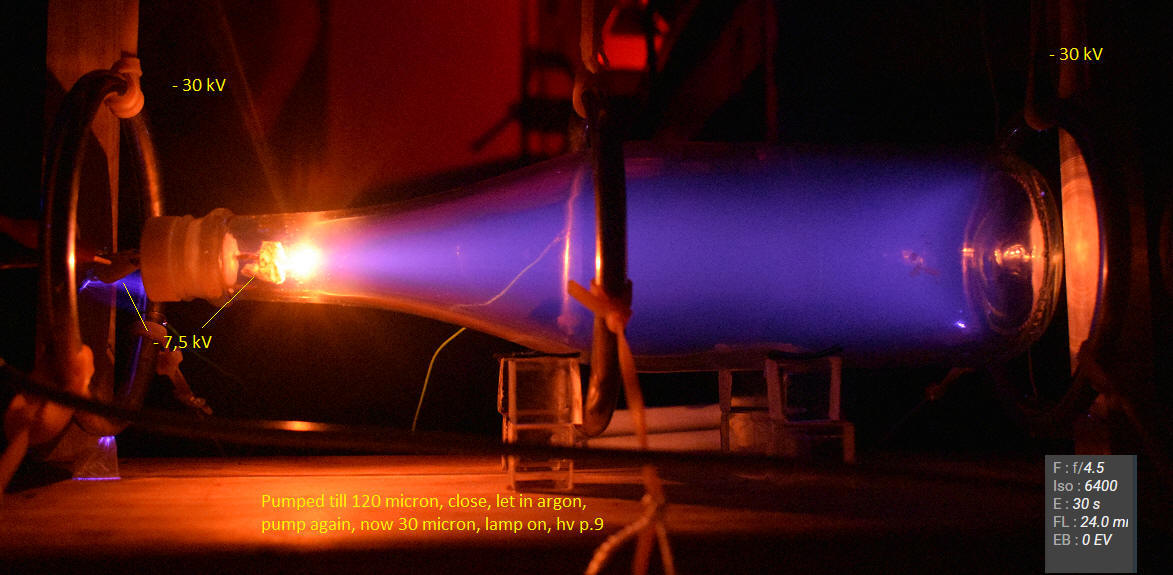
I connected the base of the lamp directly to the white oultet of the
high voltage, without resistances.
The shutter stayed 30 seconds open, too long, the picture is too
bright. But I think I saw a cathode ray (like before in
Droom17.7.htm )
When the high voltage switched on, the pressure increased till a
very high value (vacuum meter influenced by electric field? The
glycerine meter did not change..)
After closing valve both the glycerine vacuum meter as the digital
vacuum meter go up, vacuum was leaking again.
It seems to be, that when the high voltage output (the black or the
white outpute line) is directly connected to the lamp/filament, the
vacuum breaks.
---------------------
Mounted a used hose (blue) with a small incandescent
lamp/filament (this vacuum system/hose was leaking a little bit)
Connected the base of the lamp again directly to the white output of
the high voltage.
Measured the current between the mid ring (not connected) and the earthed test
cable with my multimeter: 8,7 .. 11
μA in pos-. 9 (output hv supply - 30 kV) , with the two
outer rings charged with this output.
In position 8 measured 0,1 .. 0,2
μA. The electron current is from the mid ring to the earth. ((black
connection multimeter connected to the mid ring, red connection to
the earth).
It seems to be that the mid ring is charged
negatively through the air , but only when the high voltage is at
maximum (- 30 kV).
By the way, in position 1, the current through the 500 MΩ
resistance to earth was 2,3
μA
According to my experience until now, the cap/vacuum hose will
not deteriorate by the high voltage, because it is "protected" by
the high resistance of 500 M ohm.
Lamp/filament on or off made apparently no difference.
Vacuum between 22 and 700 micron. With less then about 75 micron
the glow was somewhat less bright.
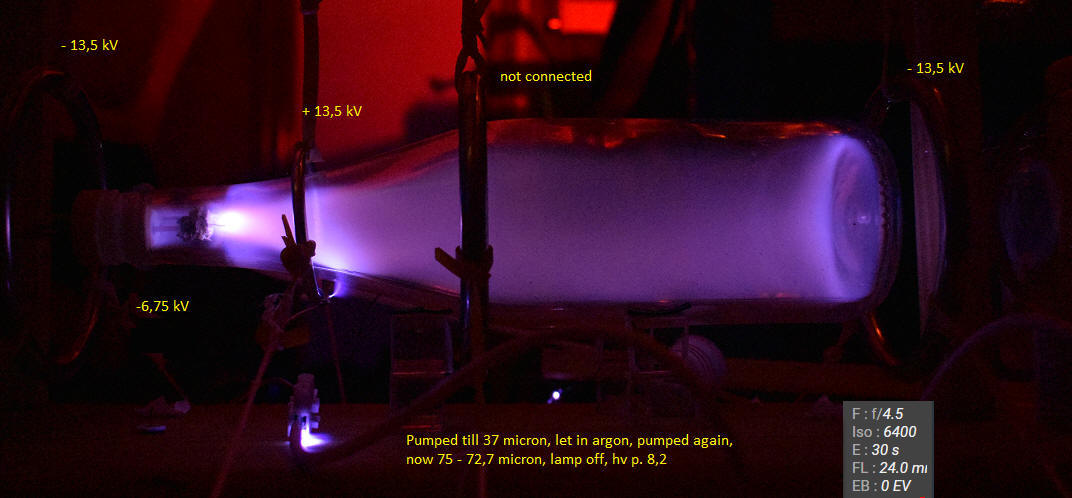
When the base/filament was connected to - 14 kV in the first
etc. experiments (directly, without resistance), a clear ray/glow
was seen that could be recorded directly (without a shutter time of
10, 20 or 30 s):
Now the base/filament was connected to - 6,75 kV, via a resistance
of 500 M ohm, and the ray/glow is a lot dimmer.
After I switched off the high voltage and the lamp, still
some dim glow was seen, as if the residual gas was still a bit
ionized and hot.
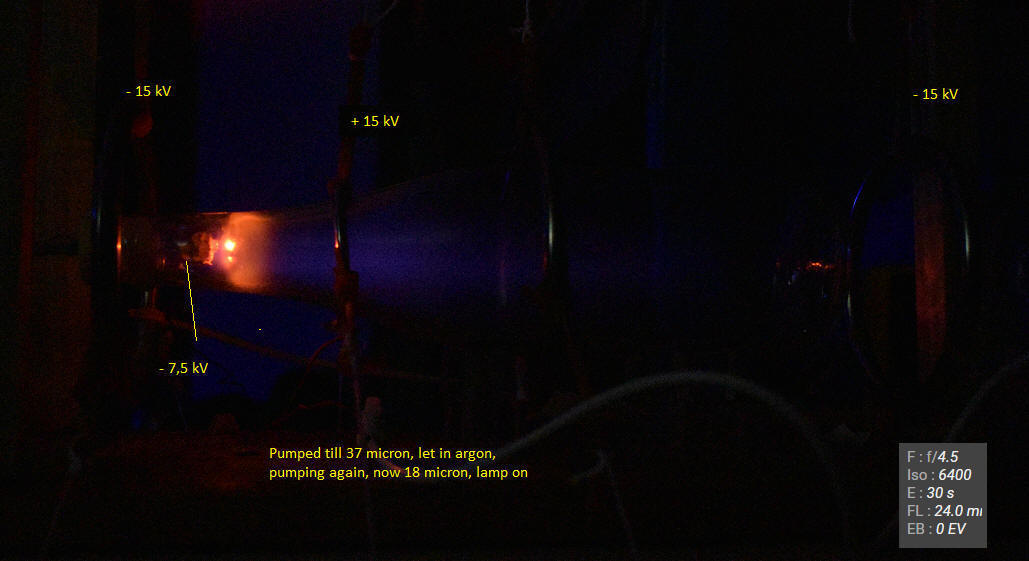
If a spark is made with the grounded test cable and the - feed of
the lamp/filament (which is also connect to - 7,5 kV), then some
more glow is seen, but only when there is a spark. When the grounded
test cable touches the - feed, no more glow is seen.
AI: Why the spark triggers glow
When you touch a ring
with your grounded cable:
You suddenly collapse
or distort the electric field.
You create a rapid
transient.
That transient
accelerates free electrons already present in the gas.
Avalanche ionization
occurs.
You get a brief
glow discharge.
This is classic
Townsend → glow discharge behavior at 10–50 micron pressure.
It is not a beam.
It is a plasma ignition.
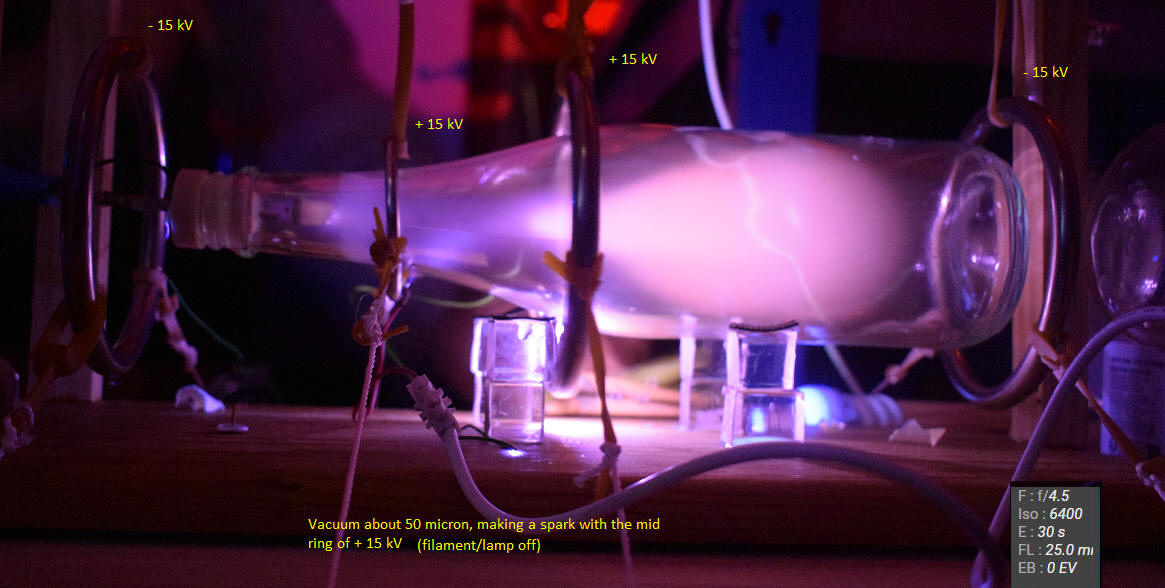
When making a spark with a
certain lenght, this glow appeared. When making a contact between
the earthed test cable and the mid ring, no glow appeared.
Making a spark produced probably an varying electromagnetic field
(my computer screen went also off something, when making a
spark...), and I think my digital vacuum meter got damaged because
of this.
Perhaps better make a kind of Faraday cage around my new digital
vacuum meter, when it arrives. And not making this sparks anymore
(only with a low voltage, to test).
------------------------
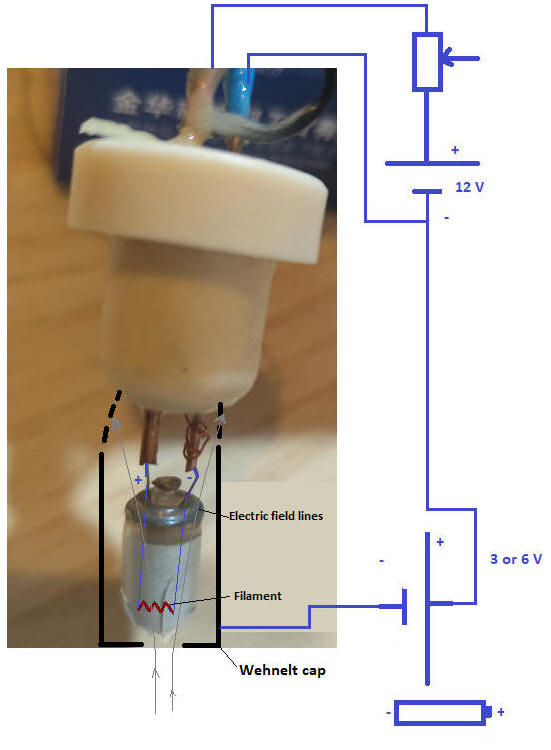
AI:
A Wehnelt cylinder (or cap) is a
critical electrode in thermionic electron guns—used in
electron microscopes and cathode ray tubes—that focuses and
controls the emitted electron beam.
Positioned around the cathode filament, it acts as a
negative, convergent electrostatic lens, condensing electron
spray into a tight, intense beam ("crossover").
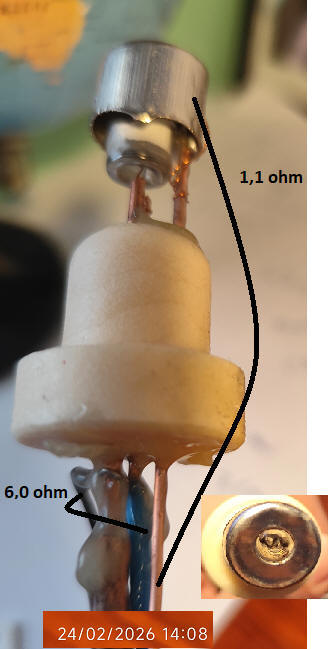
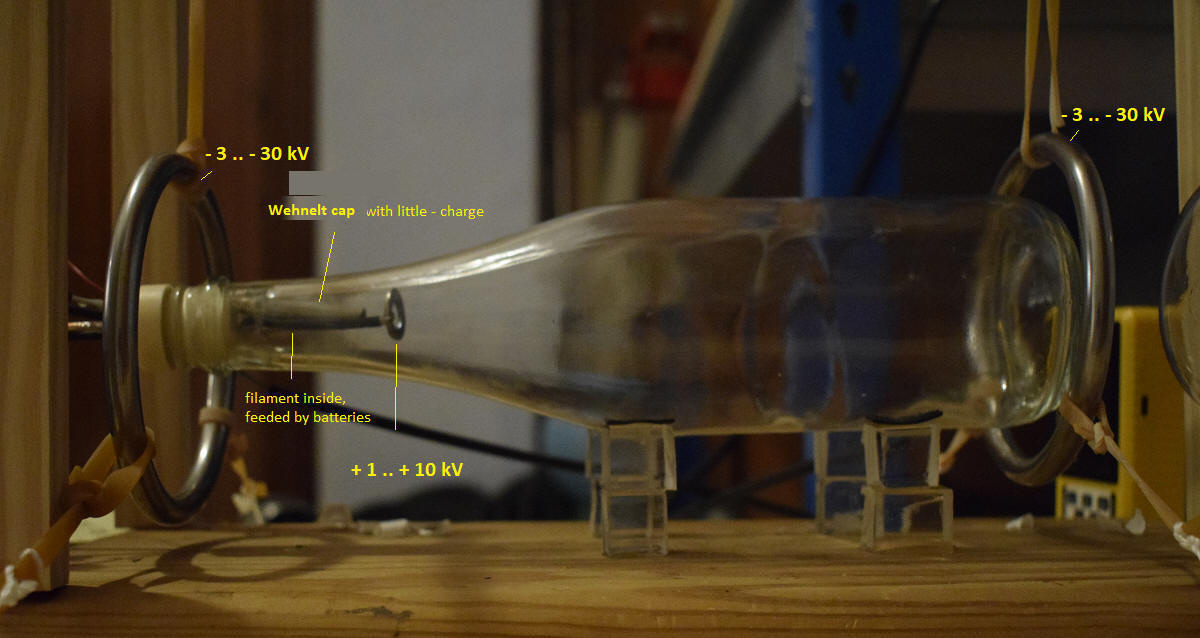
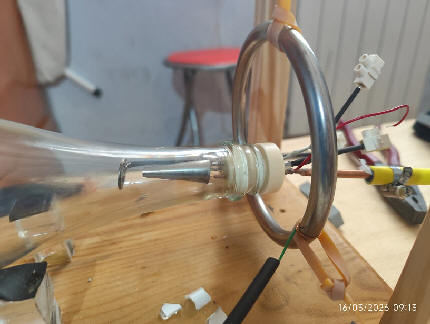
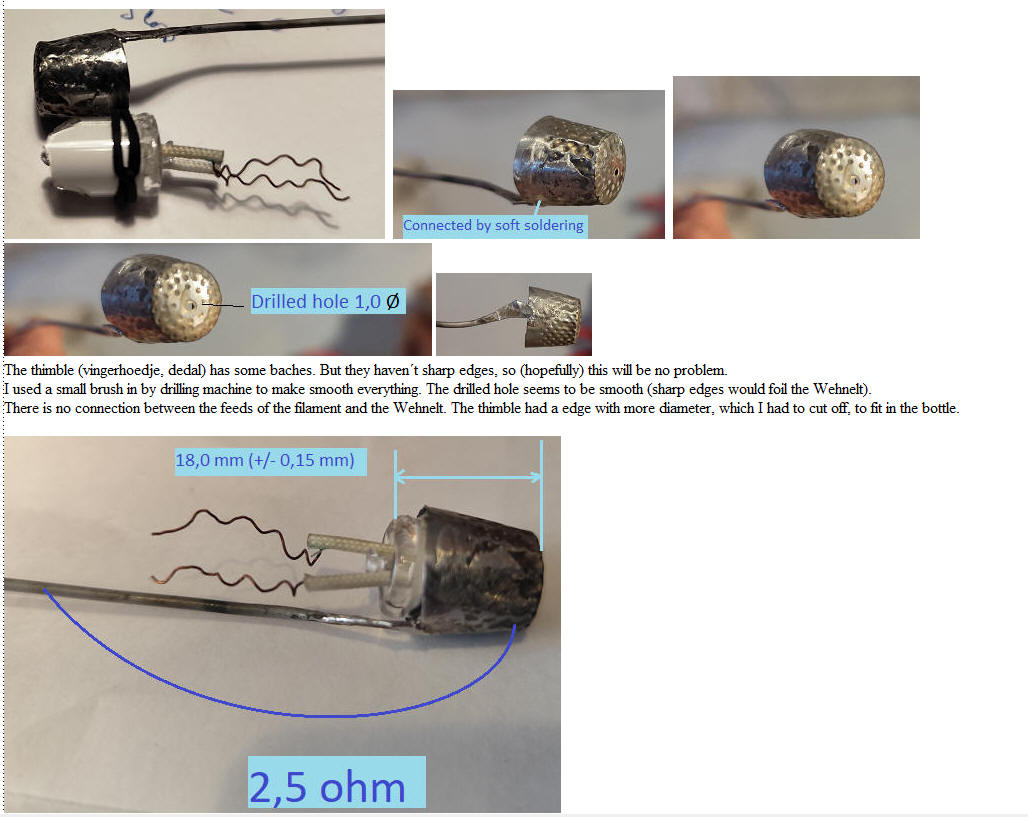
I made a Wehnelt cylinder.
The electrical scheme.
For the moment nice photos, but
not producing a real electron ray from the filament.
16-3-2026
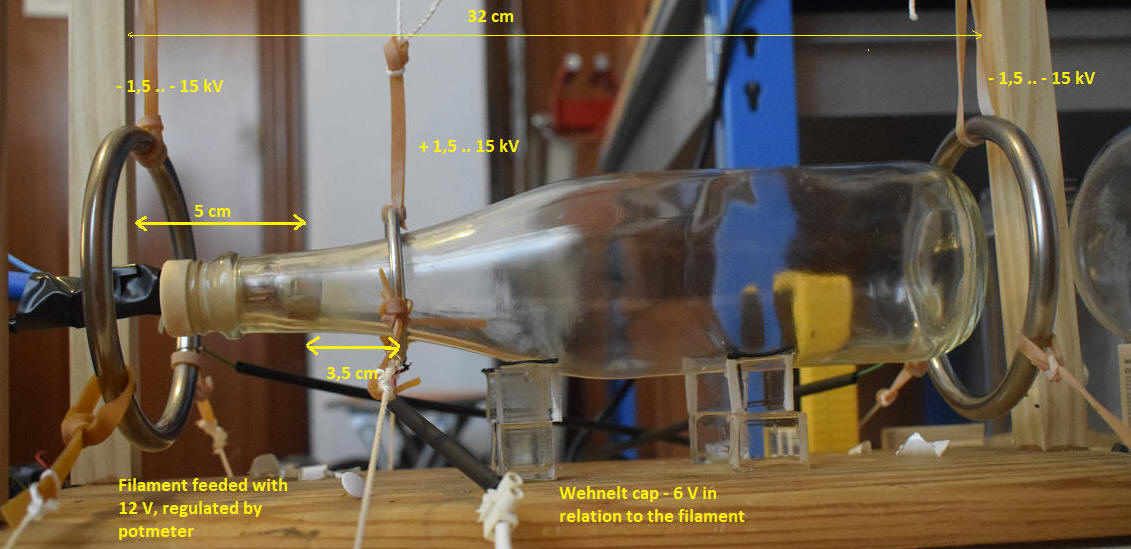
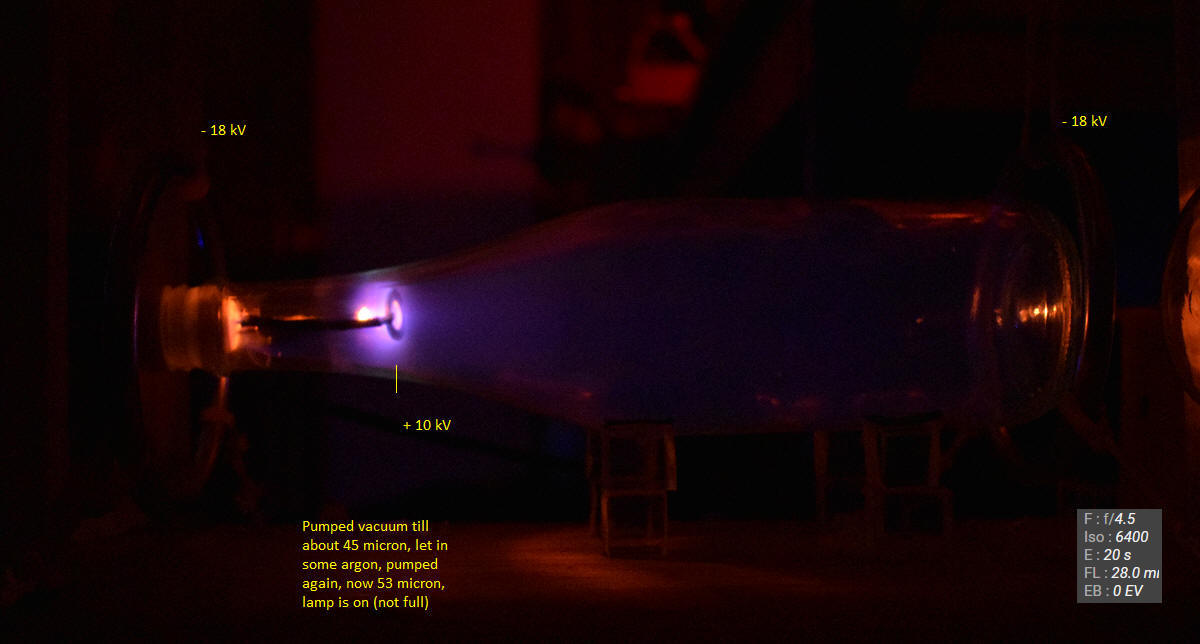
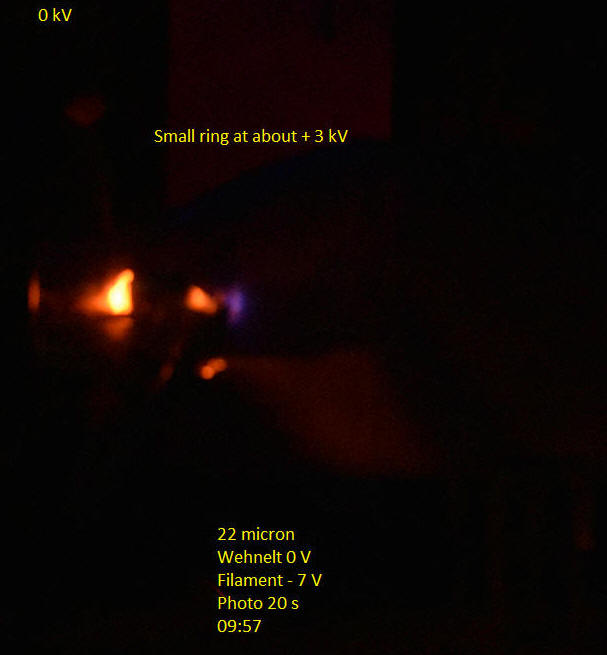
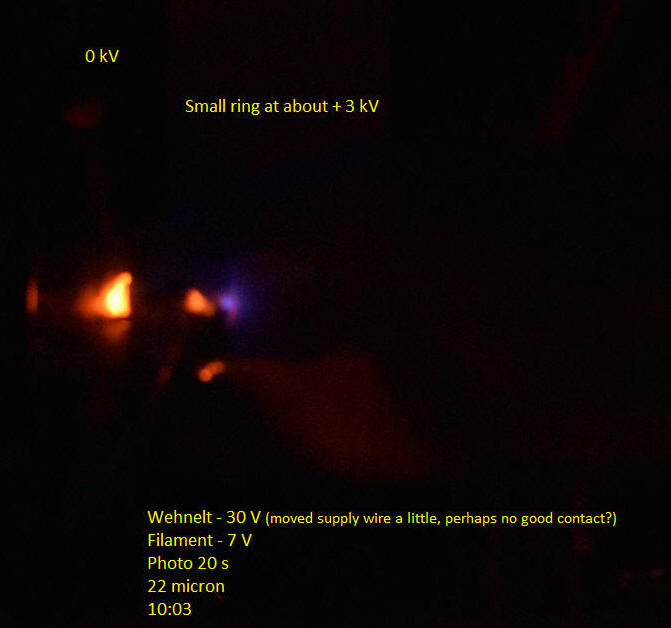
I placed a small ring ahead of
the Wehnelt cap and connected it to a high voltage supply of + 1 kV
till + 10 kV.
Here it looks that there is a
faint ray coming out of the ring.
I will continue :) (looks
like in June 2026)
August 2026
The vacuum is good, but I still
not manage to create a nice electron ray.. In the photo above I used
cap nr. 3 (because nr. 1 had some micro leaking). But cap nr. 3 is
not so
nice alligned. I will make again a new cap with the Wehnelt of cap.
nr. 1.
There seems a little difference
in the glow with the Wehnelt on and off. Perhaps I´ll make a new
Wehnelt, with the
thimble more smooth (anyway the plane with the hole), and maybe make
the filament V-shape...